

Nine-feature overview#
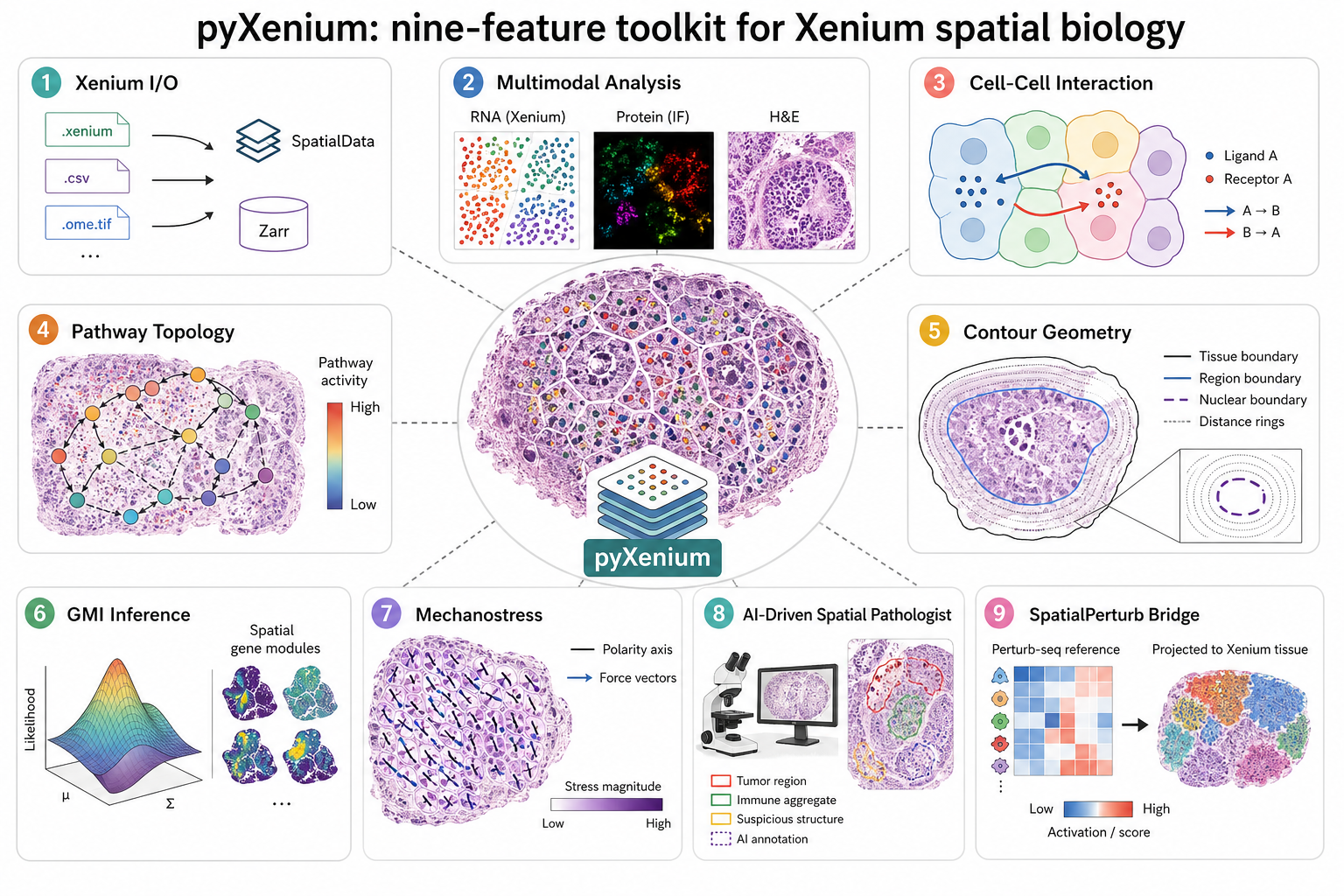
Figure 1 summarizes pyXenium as a nine-feature toolkit for Xenium spatial biology.#
The overview places pyXenium at the center because the package keeps Xenium-derived
cell tables, transcript coordinates, morphology, boundaries, and downstream handoff
metadata in one analysis-ready structure. The surrounding modules show the main
ways those data are loaded, analyzed, modeled, and handed to optional external
workflows.
Xenium I/O loads Xenium exports, recovers partial bundles, and writes XeniumSlide stores.
Multimodal Analysis prepares RNA, protein, morphology, and H&E-derived context for joint analysis.
Cell-Cell Interaction quantifies topology-aware ligand-receptor and sender-receiver patterns.
Pathway Topology maps pathway scores and pathway activity onto spatial neighborhoods.
Contour Geometry turns tissue annotations into contour features, shells, densities, and boundary-aware summaries.
GMI Inference builds contour-level matrices for sparse main-effect and interaction modeling.
Mechanostress extracts morphology-derived polarity, axis strength, and tumor-stroma growth signals.
AI-Driven Spatial Pathologist documents the optional external
spathoreview workflow around pyXenium-structured Xenium cases.SpatialPerturb Bridge writes handoff specifications for projecting Perturb-seq references onto Xenium tissue with the external
SpatialPerturbpackage.
Together, these sections separate the stable pyXenium API surfaces from optional external bridges while keeping the manuscript and documentation entry points aligned.